
The Boardwalk looks like one continuous wall of glass and concrete from the beach, but it is really fifty years of competing arguments about what a casino should be, built side by side and never reconciled. Walk it end to end and you pass a Quaker boarding-house footprint, an 1860s facade bolted to a Western theme park, a windowless fake tropical street, and a 47-storey tower that ruined two owners before it found a third. Nobody planned this skyline, which is why you can still read every decision that made it.
The address where American casino gambling left Nevada
Resorts Casino Hotel (Boardwalk at North Carolina Avenue) is where the argument starts. On 26 May 1978 it became the first legal casino in America outside Nevada, and it did not do so in a new building: the licence was grafted onto Haddon Hall, which itself grew out of an 1869 Quaker boarding house on the same plot. That inheritance is the point. Atlantic City did not invent the casino resort on empty land the way the desert did. It bolted gaming floors onto an existing hotel town, and the awkward joins are visible all along the Boardwalk once you have noticed the first one. Inside, Resorts is the easiest building in the city to walk into: an open floor, no door policy, table minimums of $10–25, and a dedicated group sales desk with meeting space if you are arriving as a pre-booked party of twelve rather than a couple. Rooms run from around $80 midweek off-season to $300 on a summer weekend, which is also a fair summary of how this whole city prices itself.
Two blocks along, The Claridge Hotel (Boardwalk at Park Place) is the architectural counter-argument to everything around it. It is the last of the great pre-casino hotels, built tall and narrow in brick when Atlantic City still sold sea air rather than slot machines, and it reads as a building meant to be looked at from the outside rather than a box designed to hold you in. It was granted local landmark status in 2026, which legally protects the facade through Vivo Investment Partners' $1bn redevelopment, a rare case here of a frontage surviving on purpose rather than by accident. There is no casino floor and so no door policy at all; Bally's gaming is next door if you want it. Rooms are $65–200, and the quiet lobby suits couples far better than the resorts do.
Immediately adjacent, Bally's Atlantic City (Boardwalk at Park Place) shows the city's architectural logic at its clearest. A genuine 1860s-lineage landmark was preserved as a facade and then wrapped in a 1997 Western theme park, so Wild Wild West now sits behind a protected frontage and you can stand in one spot watching preservation and pastiche argue inside a single building. It is also the loosest, noisiest end of this stretch. No dress code, large parties entirely routine, minimums $10–25, rooms roughly $70–250. If your group wants volume rather than polish, this is the honest answer.
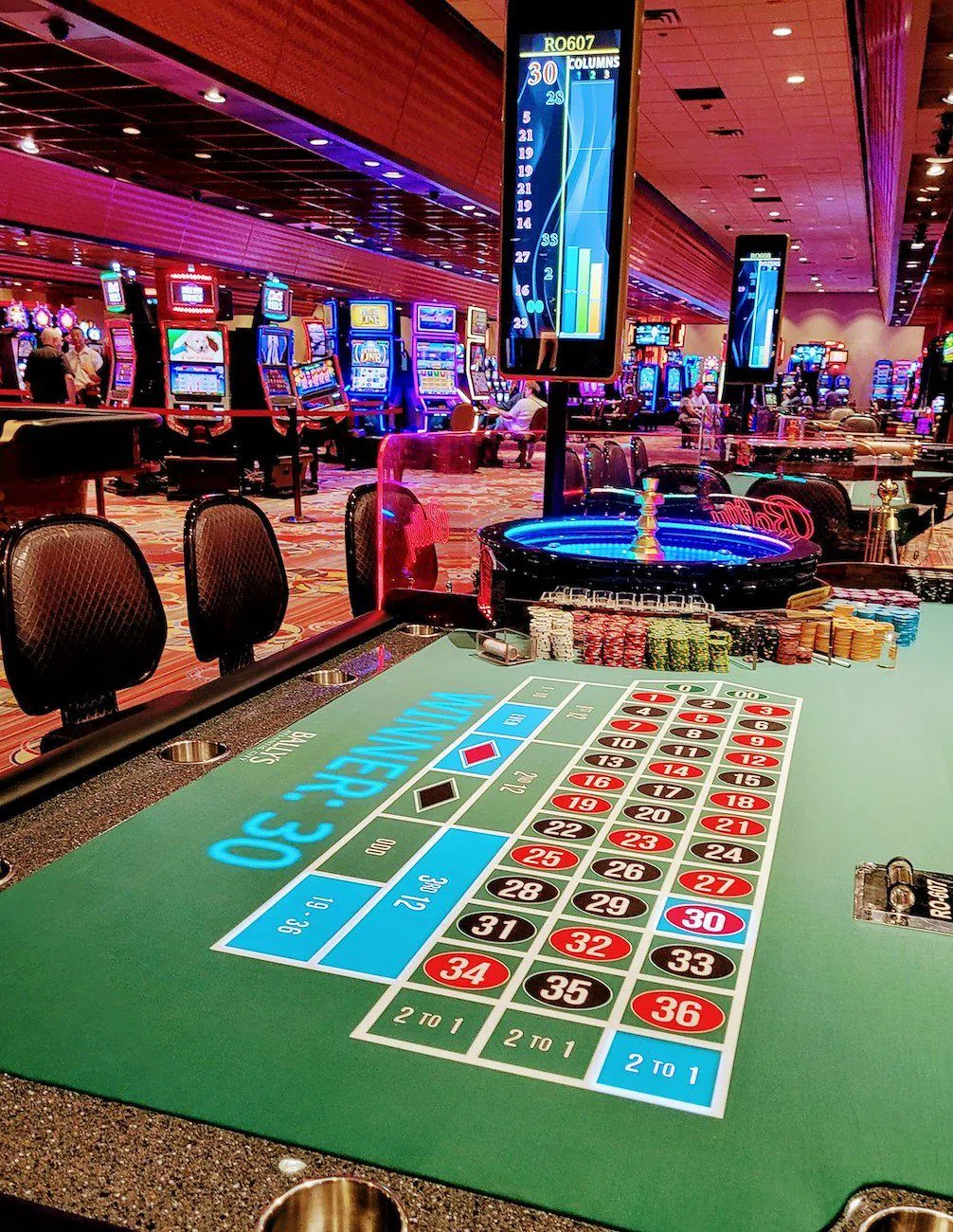
The 1979 playbook and the rooms it built
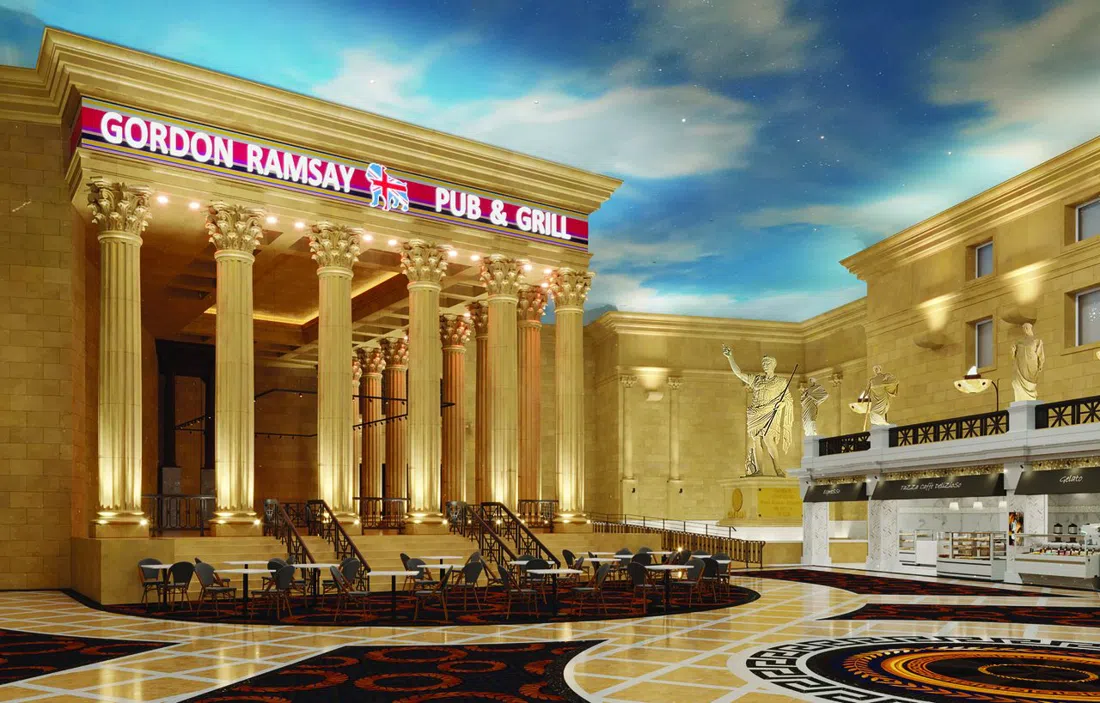
Caesars Atlantic City (Boardwalk at Arkansas Avenue) is the purest surviving example of 1979-era thematic excess on this coast: columns, statuary and the full imported-antiquity vocabulary, deployed with no irony whatsoever. It has recently been through a $200M-plus programme covering the lobby, the casino floor and 750 rooms, and it is worth seeing now, before the next renovation sands the strangeness smooth. Groups are welcome throughout, but Qua and the better restaurants prefer reservations for parties over six; arriving as nine at 8pm is how you end up eating in the food court. Rooms $90–350, tables $15–50.
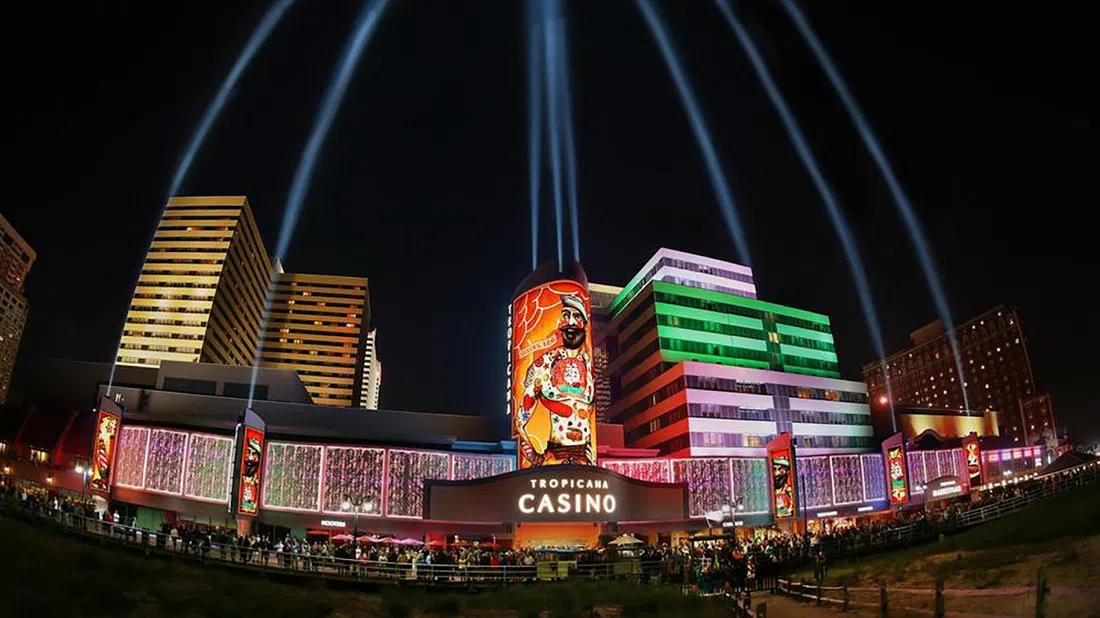
To understand how a gaming floor is actually engineered, go south to Tropicana Atlantic City (south Boardwalk at Brighton Avenue). The Quarter, opened in 2004 for $280M, is the most ambitious piece of interior urbanism in the city: a complete fake Cuban-style street with painted sky, balconies, cobbles and restaurant frontages, built so that you never see daylight, a clock or an exit sign. Casinos are designed to erode your sense of time and direction, and the tools stop being subtle once you look for them. Low ceilings press down over the slot banks and lift suddenly over the aisles, the carpet is busy enough to keep your eyes up at the machines rather than down at your feet, and the lighting is held at a permanent early evening. The Quarter scales that logic up to a whole district. It is built for groups, with bars and restaurants running large parties nightly and dining at $20–70 a head; the casino floor is unrestricted and minimums are $10–25.
Three buildings in the Marina District that face the water instead
Three miles from the Boardwalk, the Marina District casinos had a different problem to solve: no beach, no promenade crowd, nothing to face but a basin full of boats.
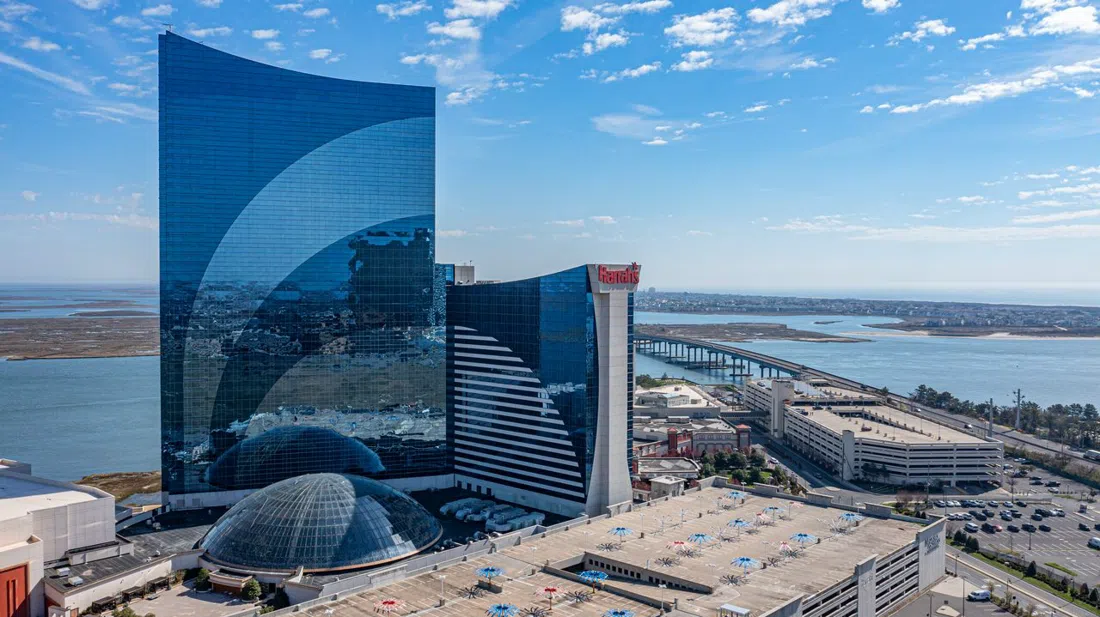
Harrah's Resort Atlantic City (Marina District) answers it with pure spectacle. The domed pool atrium is the best piece of engineered fantasy in the city, a glass-held tropical climate kept at swimming temperature three miles from a winter Atlantic. It is an absurd thing to build and a genuinely impressive one to stand inside. The resort is strongly group-oriented; The Pool After Dark runs bottle service and cabanas for parties, with entry around $20–40, cabanas into several hundred, and a nightlife dress code once the lights drop. Rooms $70–300. In daylight the atrium is calm enough for two; after 10pm it is not.
Golden Nugget Atlantic City (Marina District) is the only casino in town whose architecture is organised around boats rather than the Boardwalk, and that reorientation is the interesting thing about it: the building watches the water the way the old Boardwalk hotels watched the beach. It completed a multimillion-dollar refit in April 2026, with a new slot floor and a redesigned atrium, so it is currently the freshest of the marina trio. Groups are fine, the marina-side restaurants take large bookings, the floor is unrestricted, minimums are $10–25 and rooms a reasonable $60–230.
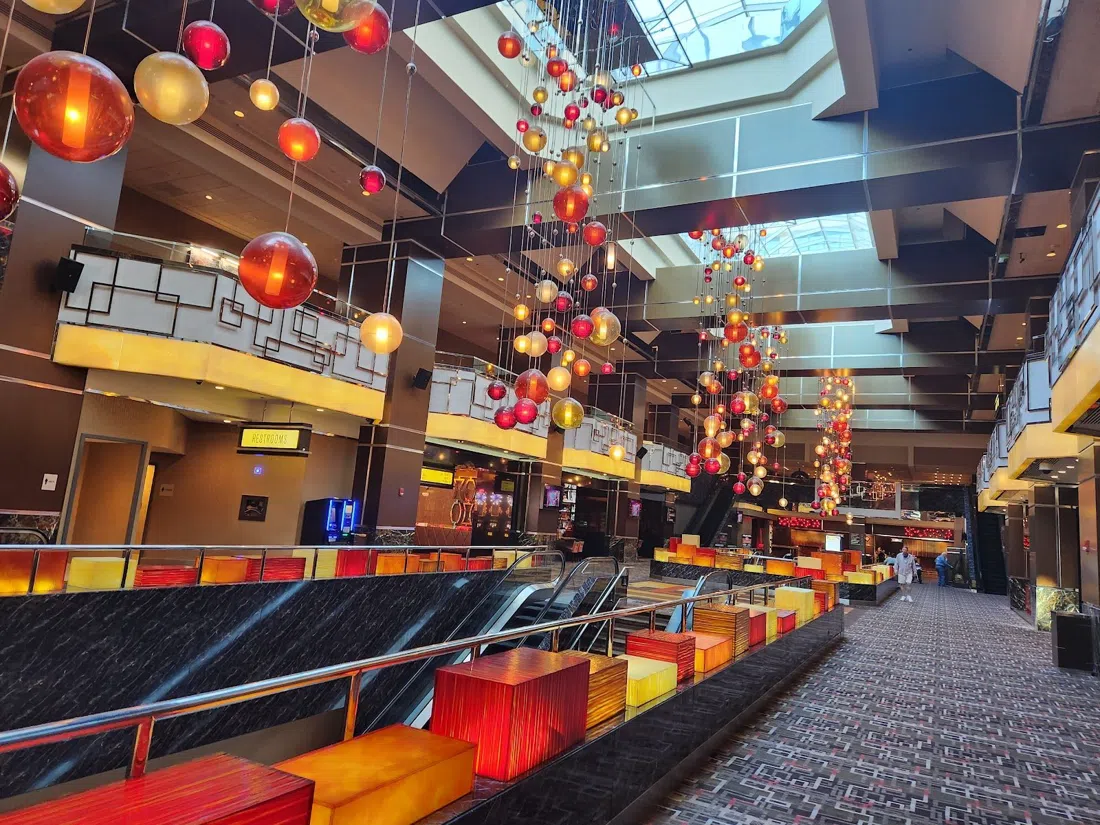
Borgata Hotel Casino & Spa (Marina District) is the break point in the whole story. When it opened in 2003 it refused theming outright (no antiquity, no tropical street, just bronze glass and real Chihuly glasswork) and in doing so it reset the city's quality benchmark, where it has stayed ever since. It is the main group destination here: nightlife, spa and restaurant group bookings are all standard, though the clubs expect something smarter than Boardwalk shorts. Prices follow the quality, with rooms $120–450 and tables $25–100.
Where the city subtracted a building and where it overbuilt one
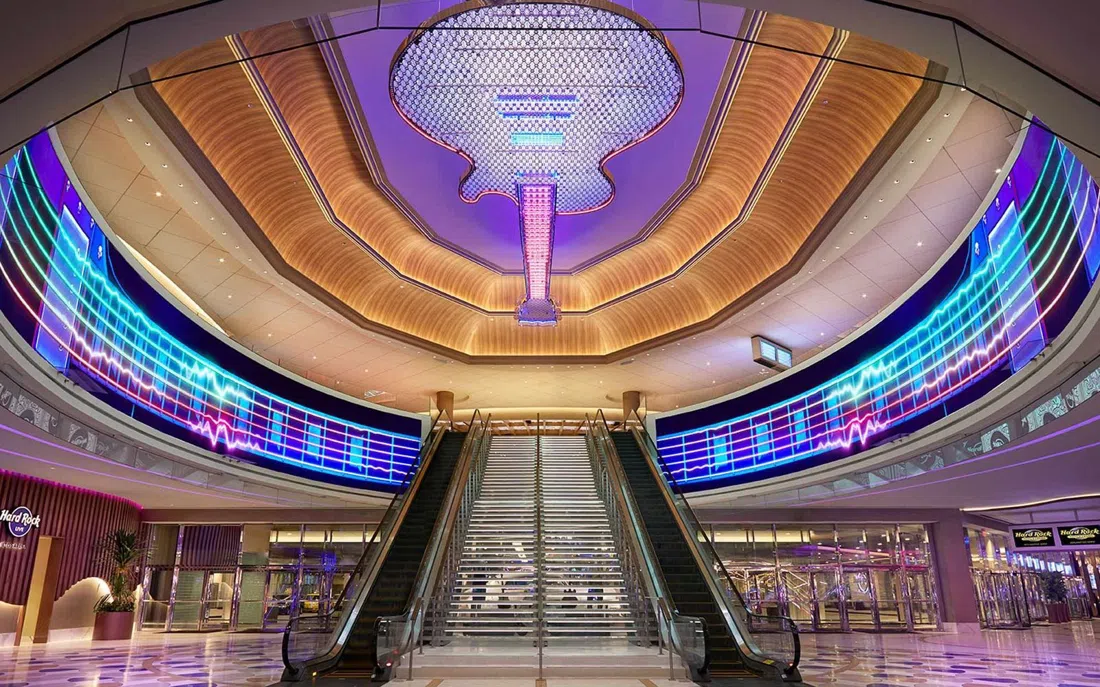
Hard Rock Hotel & Casino Atlantic City (north Boardwalk at Virginia Avenue) is the most instructive building in Atlantic City precisely because of what is missing from it. The Taj's domes and spires were physically dismantled in 2017–18, deliberate architectural erasure, and you can still read the flattened roofline where they came off. Stand across the Boardwalk and look up before you go in. The big rooms, Etess Arena and Sound Waves, are built for crowds; groups are welcome, minimums $15–50, rooms $90–350.
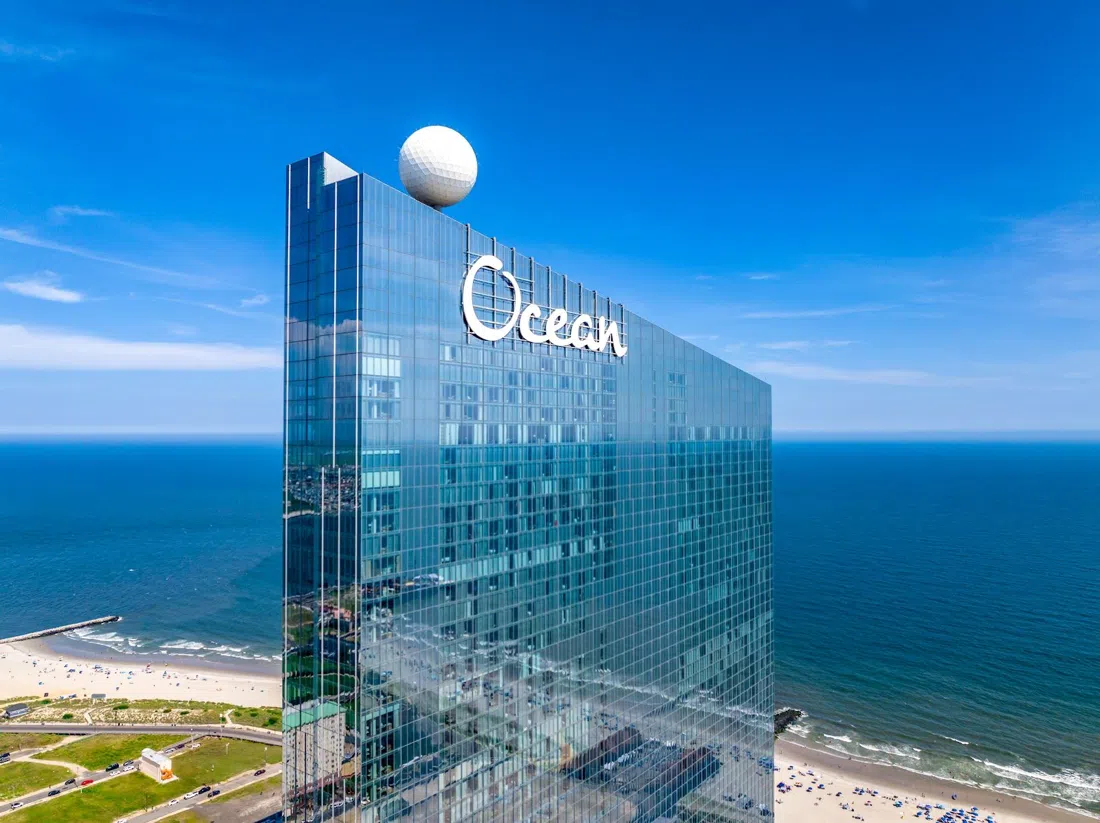
A few hundred metres north, Ocean Casino Resort (north Boardwalk, South Inlet) is the other extreme. Arquitectonica's 47-storey glass tower was built as Revel for $2.4bn, failed twice, and reopened as Ocean in 2018. It is the most expensive and easily the most beautiful building in the city, and it is also the proof that architecture alone cannot save a casino, a lesson the industry learned here at full price. Ilitch Gaming took full control in August 2026. The Topgolf Swing Suite, HQ2 nightclub and the beach club all take large bookings; rooms $110–400.
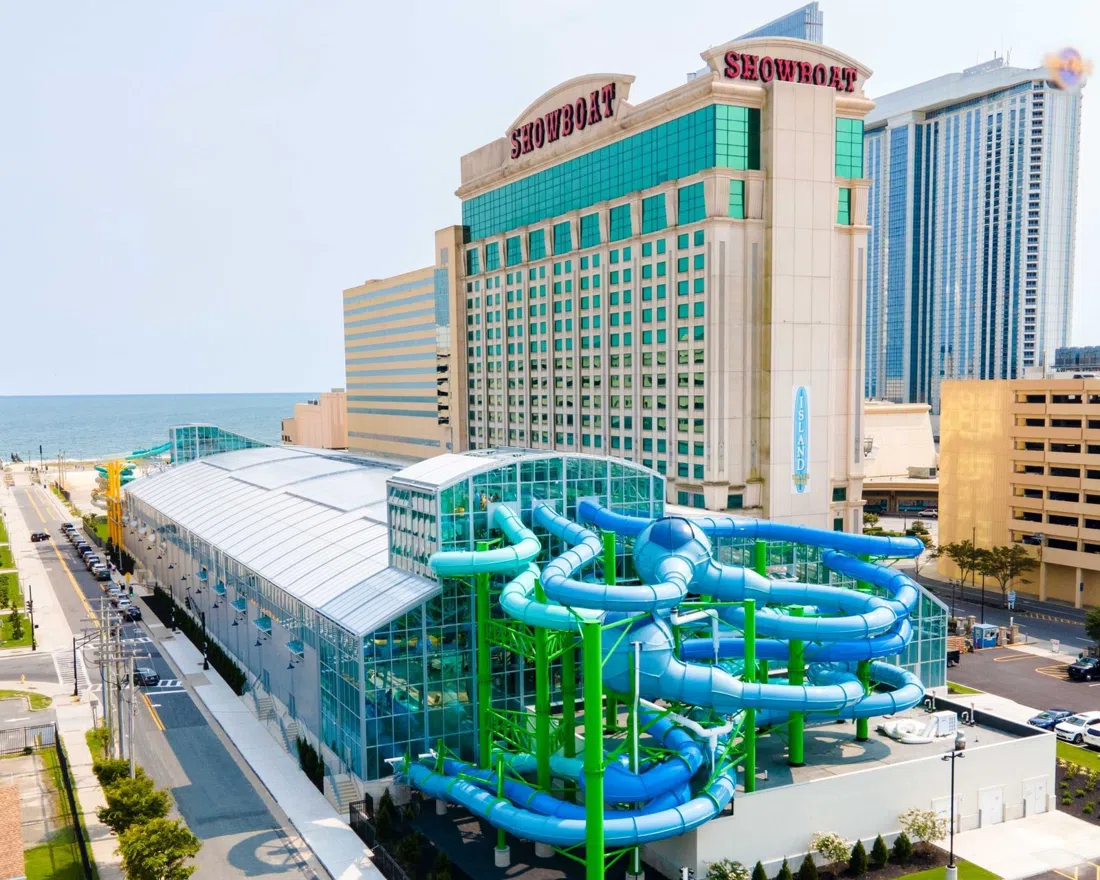
At the north end, Showboat Resort Atlantic City (north Boardwalk, Inlet) is the control experiment. A themed casino from 1987, it lost its gaming licence in 2014 and reopened as a casino-shaped building with no casino inside it: the same massing, the same arrival sequence, the same windowless core, now holding a waterpark and an arena. Bart Blatstein is still adding to it in 2026, with fairgrounds, a Nerf arena and a dinosaur attraction. It is built for groups and families and absorbs very large parties without strain; waterpark day passes run roughly $50–90 and rooms $60–250. It is the one building here that answers what a casino actually is, architecturally, once you take the gambling out of it.
The buildings the casinos were measured against
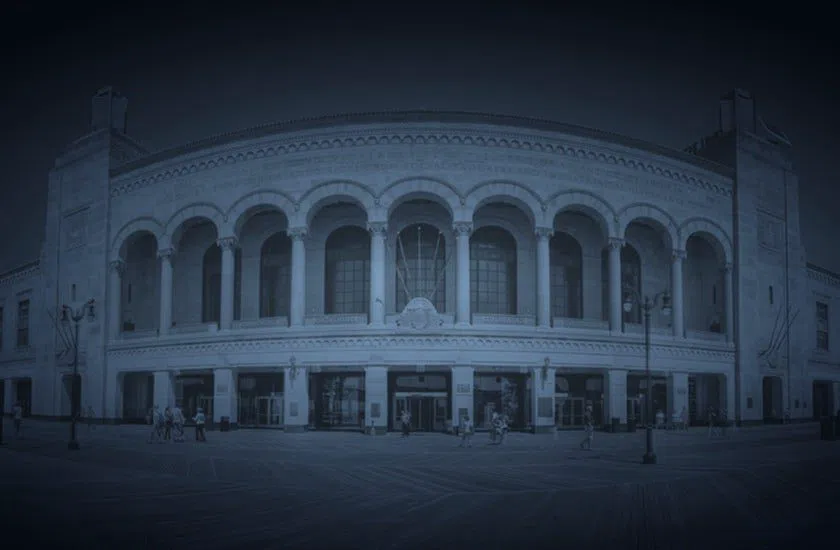
Jim Whelan Boardwalk Hall (Boardwalk at Mississippi Avenue) came first, and it set the bar. This is pre-casino civic ambition at a scale the resorts spent decades trying to match, and the Midmer-Losh organ inside is the most extraordinary machine in the city. As of September 2026 it is about 50% restored and 64% playable, which means you can finally hear it rather than just read about it. The free Behind the Scenes organ tour runs every Wednesday at 10am with preregistration required, and from May to September there is a free noon recital and tour Monday to Friday. Go. It costs nothing and it recalibrates everything else you will see that day.
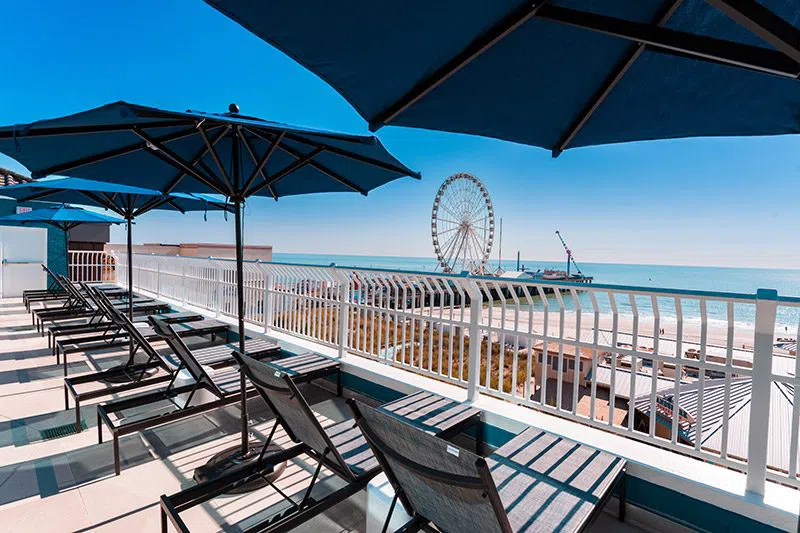
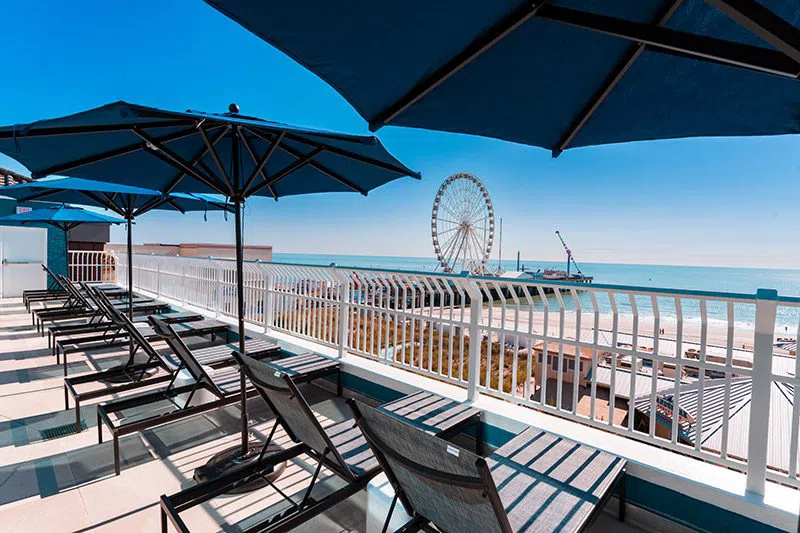
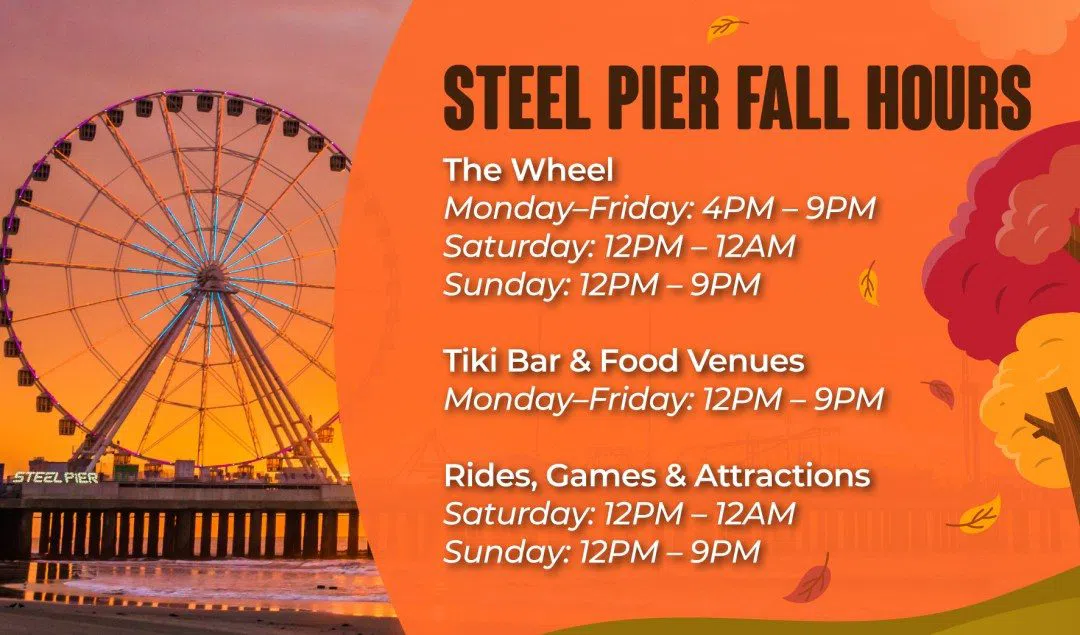
Steel Pier (Boardwalk opposite Hard Rock) is the surviving fragment of the entertainment city that existed before gaming, and its observation wheel is the best vantage point for reading the skyline as one object: sixteen minutes, the whole Boardwalk laid out, the Marina towers behind it, the Inlet to the north. The wheel is about $15 for adults and $12 for children, ride wristbands $40–50, with group rates and wristband deals for larger parties. Core season begins in early April and winter operation is limited; the wheel will not run below 40°F, so do not build an evening around it in January without checking.
Absecon Lighthouse (the Inlet) is older than the Boardwalk itself, the only building in Atlantic City that can say so, and it was the original vertical landmark, the one the casino towers were later measured against. It is 228 steps to the top, $7 for adults and $4 for children aged 4–12, open Thursday to Monday 11am–4pm from September to June and daily 10am–5pm in July and August. Groups are welcome but should book ahead, because the stair is narrow and strictly single-file.

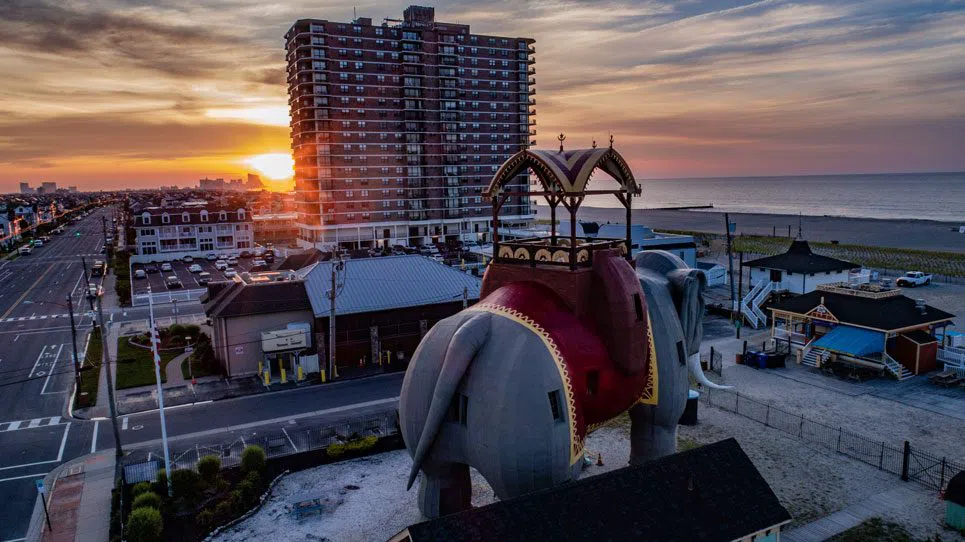
A short drive south along the shore, Lucy the Elephant (down the coast from the casino strip) is the direct ancestor of every themed casino in this article: a building shaped like its own advertisement, put up long before anyone thought to stage antiquity around a gaming floor. Fully restored in 2022 for $2.4m, she runs guided tours every 30–45 minutes, year-round 10am–5pm with extended summer hours, at around $12–14 for an adult tour; the site and gift shop are free. Larger groups must book ahead, because the interior holds very few people at once.
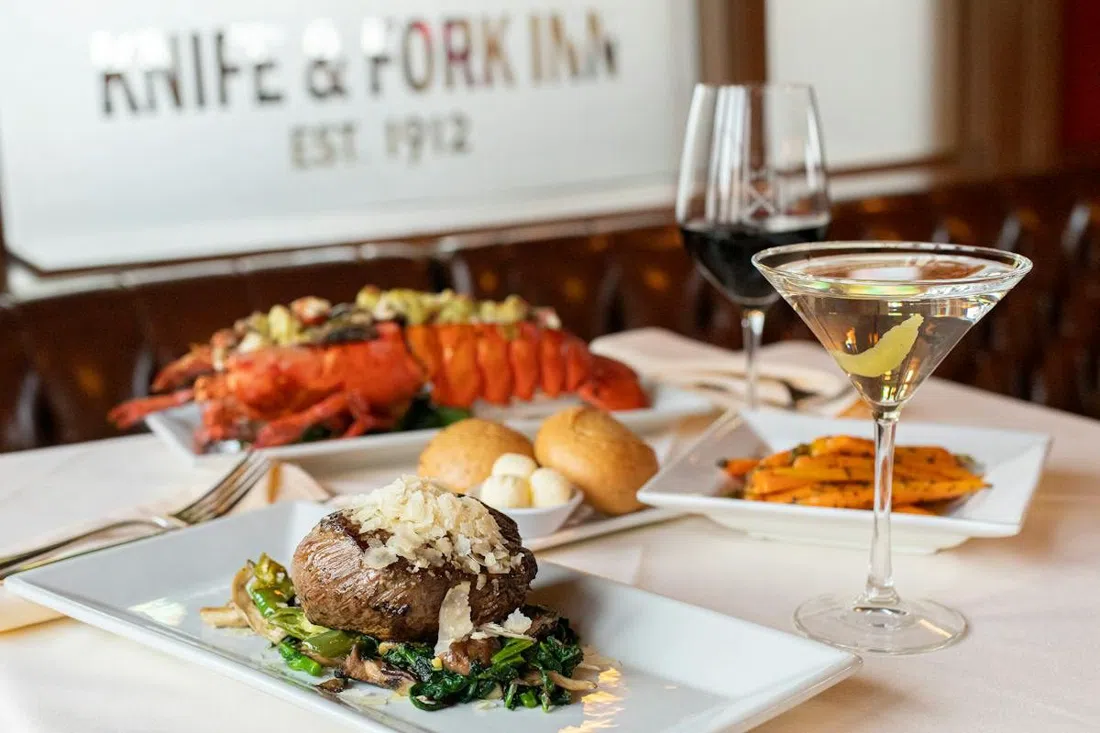
Finish at Knife and Fork Inn (Pacific Avenue at Albany), which was built as a private drinking club for Commodore Kuehnle's political machine during the Prohibition years and is the city's oldest intact piece of theatrical architecture, a deliberately odd building that was always meant to signal secrecy and status from the street. It is still a working restaurant rather than a museum, which is the best thing about it. Groups are taken and private dining rooms are available; otherwise the room suits couples and parties of four better than ten. Open Monday to Thursday and Sunday 4–9.30pm, Friday from 11.30am, Saturday 4–10pm. Mains $35–70, and expect $80–120 per person with wine.
Walking it in one day
The Boardwalk runs about four miles, but the stretch that matters here, Showboat at the north end to Tropicana at the south, is roughly two and a half miles. That is an hour at a steady pace with no stops and most of a day with them. A workable order: Absecon Lighthouse first, since the climb is better before the crowd arrives, then Showboat, Ocean, Hard Rock, Steel Pier, Resorts, The Claridge, Bally's, Boardwalk Hall, Caesars and Tropicana. Reorder around the Wednesday 10am organ tour if your dates allow it. The Marina District is a separate half-day trip, and Knife and Fork is a twenty-minute walk inland from the southern end. For rooms across all of the above, start with the Atlantic City hotel search; for everything outside this article, the Atlantic City guide covers the rest of the city.
Practical notes
Getting around is simple. The Boardwalk is the spine and Pacific Avenue runs parallel one block inland, which is where the jitney minibuses operate around the clock, the cheapest way to cover those two and a half miles when your legs give out. The Marina District sits about three miles off the Boardwalk, so plan on a jitney or a short cab rather than a walk. Lucy the Elephant needs a car or a taxi; it is a ten to fifteen minute ride south.
Carry cash. Table buy-ins are cash, and the ATMs on casino floors charge hard for the convenience, so draw before you arrive. Dealers are tipped. The lighthouse, Lucy and the pier wheel are all small-ticket and faster in cash even where cards work.
On timing, May to September is the only window for the free weekday organ recitals and full pier operation, so that is the season if the architecture is the point of the trip. Midweek off-season is when rooms drop toward $60–90 and tables stay at the $10 minimums; summer weekends reverse both. Winter is fine for the interiors, which is most of this list, but assume the wheel is closed.
The budget is modest. A full architecture day costs very little in admissions, $7 at the lighthouse, $12–14 for Lucy, nothing at Boardwalk Hall, about $15 for the wheel, so under $50 a person before food. Dinner is $80–120 per person with wine at Knife and Fork, or $20–70 in The Quarter. Rooms span $60 midweek off-season to $450 at Borgata in high season.
As for dress and doors, no casino floor in this city asks for more than clean clothes, and none of them has a door policy worth worrying about. The only real standards are Borgata's clubs and The Pool After Dark once it switches to nightlife hours.